










Dealing With a Non Paying Tenant: A Guide for Exeter Landlords
A missed rent payment rarely announces itself as a crisis. It starts with one late transfer, then a second, and before long an Exeter landlord is staring at a spreadsheet that no longer balances.
The rules for handling this changed in May 2026, and the old playbook no longer applies. When a tenant does not pay rent, knowing the correct order of steps matters more than ever, since a rushed or badly worded notice can set your case back by months.
This guide walks through exactly what to do, from the first missed payment through to court, under the framework that now governs every tenancy in England.
Key Takeaways
- Section 21 no longer exists. Every rent arrears case must now go through Section 8 of the Housing Act 1988.
- Ground 8, the main arrears ground, now needs 3 months of unpaid rent rather than 2, with 4 weeks notice.
- Universal Credit delays get stripped out of the arrears figure for Ground 8, provided the tenant was entitled to the payment.
- 80 percent of landlords report no rent arrears at all over a 2 year period, according to government survey data.
- Early, written communication remains the single most effective way to resolve arrears before they escalate.
What Should You Do the Moment Rent Stops Coming In?
Contact your tenant straight away, ideally within a day or two of the missed payment, and put your request for payment in writing. Most rent arrears cases resolve at this stage without ever reaching a notice or a court, so this first conversation matters more than any legal document that follows.
Ask what has happened before assuming the worst. A late payment can mean anything from a forgotten standing order to a genuine financial shock, and each calls for a different response.
Keep a written record of every call, text and letter from this point onward. If matters do escalate further, that paper trail becomes the evidence your case relies on.
Why the Rules Changed in 2026
The Renters' Rights Act 2025, often shortened to the RRA, received Royal Assent in October 2025 and its main provisions took effect on 1 May 2026. Section 21, the no fault notice landlords once used to end a tenancy without needing a reason, has been abolished.
Every assured shorthold tenancy automatically converted to a rolling periodic tenancy that day. From this point forward, a notice under Section 8 is the only lawful route back to possession, and rent arrears remain the ground landlords rely on most often.
|
Compliance Note: Landlords must have given tenants the Renters' Rights Act Information Sheet 2026 by 31 May 2026, or issue it at the start of any new tenancy. Missing this carries a fine of up to £7,000 per tenancy. |
Check Whether Universal Credit Is the Real Problem
A surprising number of arrears cases trace back to a delay in Universal Credit rather than a tenant who cannot or will not pay. It is worth ruling this out before anything more formal begins.
- Ask whether your tenant has applied for the housing element of Universal Credit and whether payment has been approved
- Apply for a Managed Payment to Landlord, also called an Alternative Payment Arrangement, so future rent goes directly to you
- Request a rent arrears deduction from ongoing Universal Credit payments where arrears have already built up
Full guidance on setting this up sits in the government's Universal Credit guide for landlords which covers eligibility and the application process in detail.
|
Watch for this: One rule catches landlords out often enough to repeat here: arrears caused solely by a delayed Universal Credit payment do not count towards the Ground 8 threshold, as long as the payment itself was due. |
The Grounds You Can Use for Rent Arrears
Three grounds under Schedule 2 of that Act cover unpaid rent, and landlords typically cite more than one on the same notice to cover every angle.
|
Ground |
Type |
Threshold |
|---|---|---|
|
Ground 8 |
Mandatory |
3 months arrears (or 13 weeks if rent is weekly) |
|
Ground 10 |
Discretionary |
Any amount of arrears at the date of the notice |
|
Ground 11 |
Discretionary |
Persistent delay in paying rent, even if arrears are later cleared |
Ground 8 is the one that matters most, because a court must order possession if the threshold is still met at the hearing. The arrears figure has to hold at both the notice date and the hearing date, so a tenant who pays enough to dip below three months before the hearing can defeat the claim.
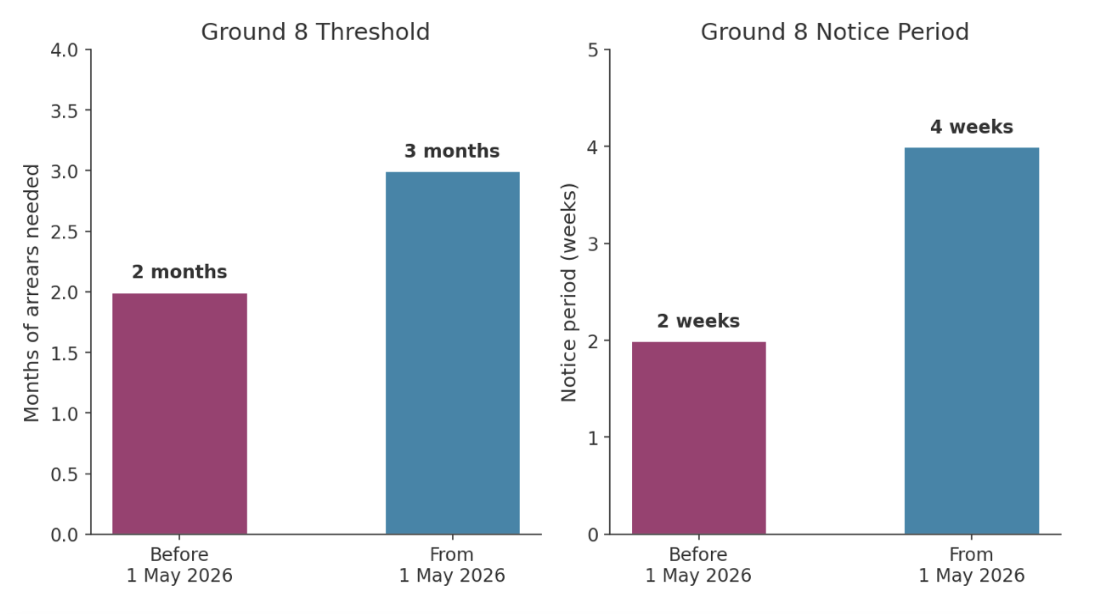
How the rent arrears rules changed on 1 May 2026.
Grounds 10 and 11 exist precisely to catch tenants who pay down arrears just before a hearing. Since neither is mandatory, the court weighs the full picture rather than applying a fixed rule.
Serving Notice and Going to Court
Every notice must now use Form 3A, the version introduced alongside the Act. The older Form 3 is no longer valid for any notice served on or after 1 May 2026, so double check you are working from the current template before sending anything.
Once the four week notice period expires and your tenant has not left, the next step is a possession claim through the county court. Full guidance on the process, including which court forms to use, sits on the government's page for evicting tenants in England.
"A section 8 notice must state which grounds you rely on and give the full legal wording of each one. Getting this wrong is one of the most common reasons a claim fails at court."
Court timelines vary by region, and current caseloads mean a straightforward arrears claim can take several months from filing to a hearing date, longer still if the case is contested.
Recovering the Money You Are Owed
A possession order deals with the property, not the debt. To recover the arrears themselves, you will usually need a separate money judgment, which the same court can often grant alongside the possession order.
- Arrears under £10,000 are dealt with on the Small Claims track
- Arrears of £10,000 or more must go through the County Court's standard track
- Most landlord insurance policies include a rent guarantee element that pays out while the claim proceeds
|
Watch: Your Renters' Rights Action Plan: April to July 2026 This video walks landlords through the practical steps for complying with the Renters' Rights Act as it took effect. |
One Progressive Lets client described their solicitor and agent keeping a close watch on a lengthy repossession case, staying proactive throughout and explaining each stage clearly. That kind of steady guidance tends to matter more once a case moves from a conversation into a court timetable.
How Common Is This, Really?
Rent arrears feel like a constant threat, yet the government's own landlord survey paints a calmer picture than the headlines suggest.
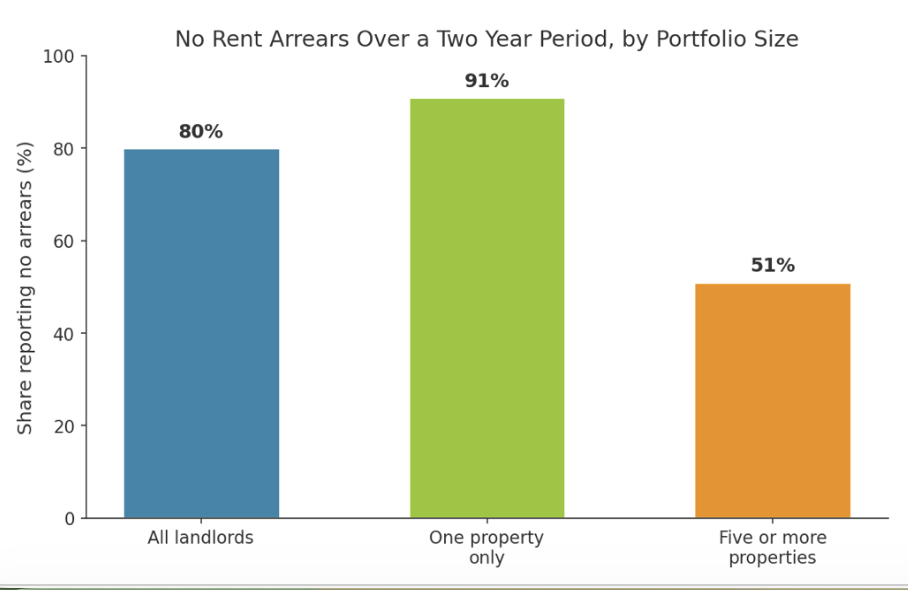
Share of landlords reporting no rent arrears over a two year period, by portfolio size.
Arrears clearly become more likely as a portfolio grows, which tracks with simple probability rather than any change in tenant behaviour. More tenancies mean more chances for one to go wrong. Landlords balancing this alongside other commitments may find our Business Daily coverage useful for the wider financial picture.
Preventing Arrears Before They Start
Screening remains the cheapest form of insurance available to a landlord. A thorough reference check, a realistic affordability assessment and a genuine conversation with the previous landlord catch most problem tenancies before they begin.
- Confirm the deposit is protected in an approved scheme within 30 days of receipt
- Keep gas safety certificates, EPCs and electrical safety reports current and easy to produce
- Set up rent collection by standing order so missed payments show up immediately, not at month end
Good property upkeep plays a role here too. Our maintenance tips for landlords cover the seasonal checks that keep a rental in the condition tenants expect, which in turn reduces the disputes that sometimes spill over into payment problems.
For Exeter landlords weighing up whether to keep, sell or restructure a portfolio, best property buying companies in the UK is a useful companion read, and our wider Homes & Gardens section covers plenty more on maintaining a property to a good standard.
Frequently Asked Questions
Can I still evict a tenant without a specific reason?
No. Section 21 no fault evictions were abolished on 1 May 2026. Every possession claim in England must now rely on a specific ground under Section 8, such as rent arrears.
How many months of arrears do I need for a guaranteed possession order?
Three months unpaid, or 13 weeks if the tenancy is weekly or fortnightly. This figure must still be met on the day of the court hearing, not only when the notice was served.
What if my tenant pays off some arrears before the hearing?
If arrears drop below the Ground 8 threshold, that mandatory ground fails. You can still pursue discretionary Grounds 10 or 11, though the court will decide based on the full circumstances rather than a fixed rule.
Does Universal Credit count against my tenant's arrears figure?
Not if the delay is the cause. Arrears that exist solely because a Universal Credit housing payment has not yet arrived, despite the tenant being entitled to it, are excluded from the Ground 8 calculation.
How long does a rent arrears case take from notice to possession?
Expect a minimum of several months once notice, court filing and a hearing date are all added together. Contested cases and busy regional courts can extend this considerably.
What documents do I need before serving notice?
A complete rent ledger, proof of deposit protection, valid gas safety and EPC certificates, and a copy of the Information Sheet given to the tenant. Missing paperwork can undermine an otherwise valid claim.
Final Thoughts
Handling this well in 2026 comes down to speed and paperwork in roughly equal measure. Contact your tenant early, rule out a Universal Credit delay, and keep every document in order so that the notice, if it becomes necessary, holds up without complication. The legal route still works. It simply asks a little more of landlords than it once did.
References
GOV.UK, Evicting Tenants in England: Overview, 2026 — https://www.gov.uk/evicting-tenants
GOV.UK, Universal Credit and Rented Housing: Guide for Landlords, 2026 — https://www.gov.uk/government/publications/universal-credit-and-landlords/universal-credit-and-rented-housing-guide-for-landlords
GOV.UK, The Renters' Rights Act Information Sheet 2026
Ministry of Housing, Communities and Local Government, English Private Landlord Survey 2024, December 2024 — https://www.gov.uk/government/statistics/english-private-landlord-survey-2024
Citizens Advice, If You Get a Section 8 Eviction Notice, 2026 — https://www.citizensadvice.org.uk/housing/eviction/getting-evicted/renting-privately/check-your-section-8-notice/
Fact Check: All statistics and data points in this article were verified against original sources as of 11 August 2026. Sources are listed in the References section.