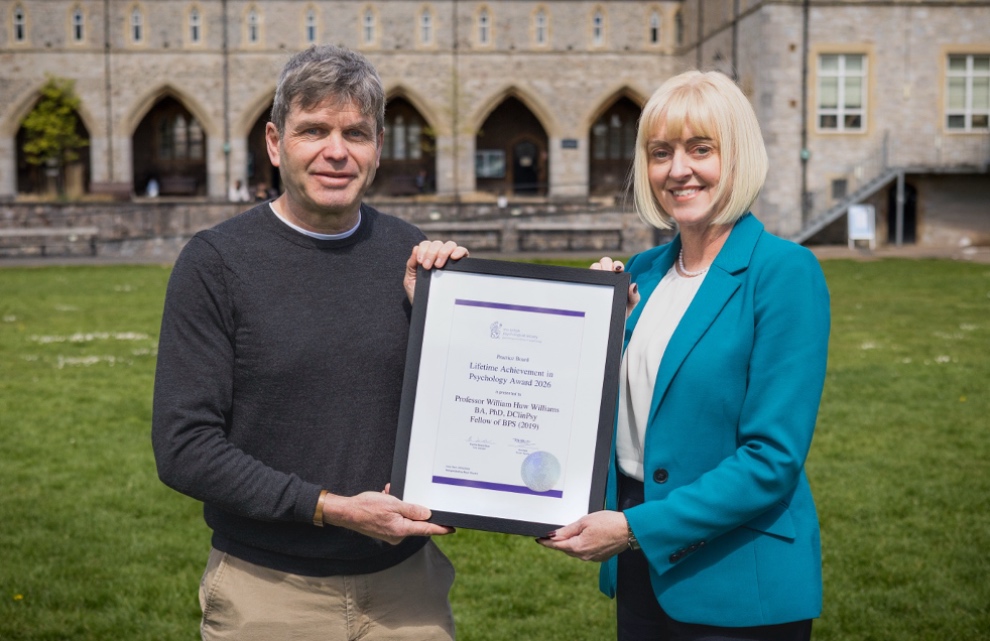









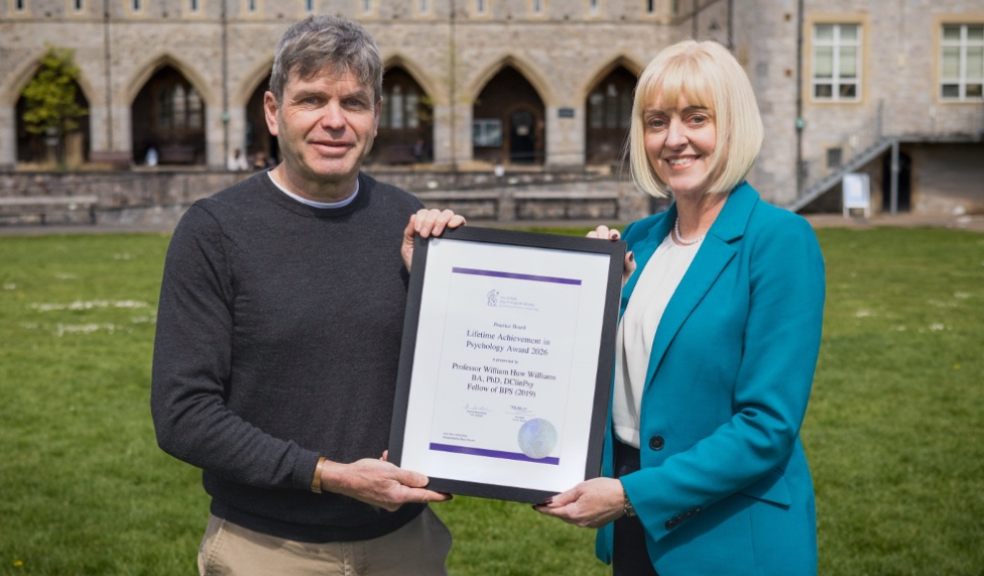
Exeter's Professor Huw Williams given Lifetime Achievement in Psychology Award
Congratulations to Professor Huw Williams, who has been awarded the British Psychological Society (BPS) Lifetime Achievement in Psychology Award.
Professor Williams, who is a Professor of Clinical Neuropsychology and Co-Director of the Centre for Clinical Neuropsychology Research at the University of Exeter, has been given the prestigious award as recognition of his expansive and influential career.
Professor Williams said: "I am delighted to receive this award, which is very much the result of working with colleagues who are brilliant, socially conscious, and informed. It is also a profound testament to the experiences of our clients, patients, and participants, who provide us with the privileged insights necessary to drive real change. Neuropsychology, in its exploration of brain system evolution and the formation of the mind, remains a field that constantly offers curious questions and fascinating answers."
Professor Lisa Roberts, President and Vice-Chancellor of the University of Exeter, said: “I would like to offer my heartfelt congratulations to Huw on his richly deserved Lifetime Achievement Award. Huw has had a stellar career, including more than 25 years at the University of Exeter, where his expertise has helped drive education, research and innovation in our global top 100 Psychology department. A key figure in clinical neuropsychology, Huw’s research has had a major impact on our understanding of traumatic brain injury, and his advice has influenced policy at the national and international level. I’m sure our entire University community would like to join me in congratulating Huw on this wonderful achievement.”
Professor Williams gained his PhD and Doctorate in Clinical Psychology from the University of Wales. Starting his clinical career in London as a Clinical Psychologist in various services, he would go on to join the founding staff team of the Oliver Zangwill Centre for Neuropsychological Rehabilitation, before becoming a Visiting Scientist at the Cognition and Brain Sciences Unit in Cambridge.
With his colleague Professor Jonathan Evans, he pioneered work in neuropsychological rehabilitation, particularly in the assessment and treatment of PTSD in traumatic brain injury (TBI). Professor Williams took up a lectureship role at the University of Exeter in 2000, progressing to Associate Professor by 2007, then Full Professor. He has also served as Secretary and then Chair of the BPS Division of Neuropsychology.
As well as this, he has been an advisor to several national bodies in healthcare and policy including NICE, the Ministry of Justice, the Department for Work and Pensions, plus international agencies and groups including the UN Office for Drugs and Crime, and the UN Global Study of Children Deprived of Liberty.
Based on his group’s research, Professor Williams has given evidence to Parliamentary bodies, including the Justice Committee of the UK & NI Parliament and the Justice Committee of the Scottish Parliament. He has also appeared regularly in Hansard and has been cited by MPs in TBI debates in the House of Commons.
His advice has led to changes in national policy and practice in the UK and globally. This included his groups’ influence on the United Nations Convention on the Rights of the Child, by adding commentaries on the importance of accounting for neurodisability as a factor to address to reduce criminalisation of children at risk.
Professor Williams has been recognised for his extensive research, spanning over 100 research papers and the impact his work has had on policy developments. Perhaps most notably, is his work campaigning for better understanding of people with TBI in prisons, and the pioneering work of his Oliver Zangwill Centre that laid the foundations for neuropsychological rehabilitation for adults with TBI.