








Chemical Safety in the Workplace: How to Protect Employees From Hazardous Substances
Most employers tend to get chemical safety wrong in one of two directions. Either they assume COSHH is something that happens to factories, or they download a 40-page template and fill it in for a cupboard of washing-up liquid. Both leave people exposed, and the second one costs a weekend.
Chemical safety in the workplace is simpler than the paperwork suggests. You need to know what is on site, keep the dangerous things apart, control exposure before you reach for protective kit, and be able to show your reasoning if someone asks. The forms are a record of that thinking, not a substitute for it.
HSE puts the long term toll at around 11,000 lung disease deaths a year in Great Britain, all of them traced back to exposure at work. Chronic obstructive pulmonary disease accounts for roughly 35 per cent of those and mesothelioma for another 20 per cent. These are exposures from decades ago arriving now, which is what makes the boring version of this worth getting right.
Here is what the rules actually ask, including two things most guides skip.
What Counts as a Hazardous Substance Under COSHH?
A product does not need a skull and crossbones on the label to be covered. Under GB CLP, hazards split into physical categories like flammable and corrosive, and health categories like toxic and carcinogenic. A can of degreaser and a bottle of bleach can both qualify.
Two things surprise people here.
The first is that workplace chemical hazards do not have to arrive in a container at all. HSE describes what COSHH covers as including dusts, gases and fumes you breathe in, alongside liquids, gels and powders. Wood dust from a saw and fumes from a welding torch sit inside the regulations even though nobody bought them.
The second is that the duty attaches to what a substance does to a person, not to how it is sold. "Natural" and "non-toxic" on a label decide nothing, because neither phrase has any standing in the regulations. An eco-branded degreaser is judged on what it actually contains.
So the first job, however small the workplace, is an honest list of what is really on site rather than what should be. A spreadsheet nobody has opened since an employee left will miss the drum that turned up last month.
Which Hazardous Substances Does COSHH Not Cover?
Three substances sit outside COSHH altogether, and nothing on the label announces it. HSE states it plainly: lead, asbestos and radioactive substances have their own regulations instead. Asbestos falls under the Control of Asbestos Regulations 2012, lead under the Control of Lead at Work Regulations 2002, and radioactive material under the Ionising Radiations Regulations 2017.
That matters more than it sounds. If you find suspected asbestos in a Victorian shopfront during a refit, a COSHH assessment is the wrong instrument and will not protect you legally. A thick COSHH file can sit quite happily alongside an uncontrolled duty somewhere else.
Does a COSHH Assessment Have to Be Written Down?
The answer turns on headcount, which is why so many employers either overdo the paperwork or avoid it entirely. HSE puts the rule in one sentence: all employers must carry out a risk assessment, and those employing five or more employees must also record the significant findings.
Below five, the duty to assess and control does not disappear. It is only the writing down that relaxes. A two-person workshop still has to work out what could hurt someone and do something about it.
This is the single most useful thing an employer can know about hazardous chemical safety, and it is buried almost everywhere. Customers may ask regardless. Facilities managers and main contractors often want to see assessments before awarding work, so plenty of businesses below the threshold keep records for commercial rather than legal reasons.
If you do write one, it needs to show the substances, who is at risk, what the controls are, and when you will look at it again. Four columns, not forty pages.
Keeping assessments current is where most employers lose track. Products get reformulated, suppliers change, and a file that looked complete last year no longer matches what is on the shelf. COSHH risk assessment software keeps each assessment attached to its substance and its review date, which is the job a spreadsheet does badly once the list runs past a handful.
How Should You Store Hazardous Chemicals in the Workplace?
Storage mistakes are rarely about ignorance. They are about convenience. The empty shelf happened to sit next to the acids, so the oxidiser went there too.
Separating by hazard class fixes most of it. Flammables go away from oxidisers, acids away from bases, and containers stay shut except when something is actually being poured. Anywhere holding flammable or strong-smelling products needs local exhaust ventilation, which costs a great deal less than a hospital visit.
Three details get missed more often than the segregation rule itself. Substances should stay in the container they came in, and anything decanted needs a label at the moment it is decanted rather than later that afternoon. Storage should be reachable only by people trained to use what is in it, usually a lockable cupboard and one named keyholder. And the safety data sheet will often specify a temperature range, which is easy to overlook in a storeroom that bakes every July.
Where Should Safety Data Sheets Be Kept, and Who Provides Them?
Plenty of businesses pay for information they were entitled to have for nothing. HSE is specific about where safety data sheets come from: if a substance is dangerous for supply, the supplier must send you a data sheet when the product is first ordered, if the formulation changes, or if you ask for one. Emailing the merchant is usually the whole procedure.
Where they get kept matters just as much as having them. A sheet that lives in a binder in the office is no use to someone holding a leaking container in the yard at half past four. It needs to be reachable from the floor, on a phone or a shared screen. Closing that gap is what SDS management software is built for.
Why Does COSHH Put PPE Last in the Control Order?
Gloves fail quietly, which is the whole reason protective equipment sits at the bottom of the list rather than the top. A control that depends on someone remembering, choosing correctly, and wearing it properly every time is weaker than one built into the room, so the order runs:
- Stop using the substance, or swap it for something less harmful.
- Contain the process so the substance cannot reach anyone.
- Ventilate, so what does escape gets taken away.
- Then issue PPE for whatever exposure is left.
Most workplaces jump straight to step four, because it is the cheapest thing to buy and the easiest thing to show an inspector. It is also the step most likely to fail on a Friday afternoon.
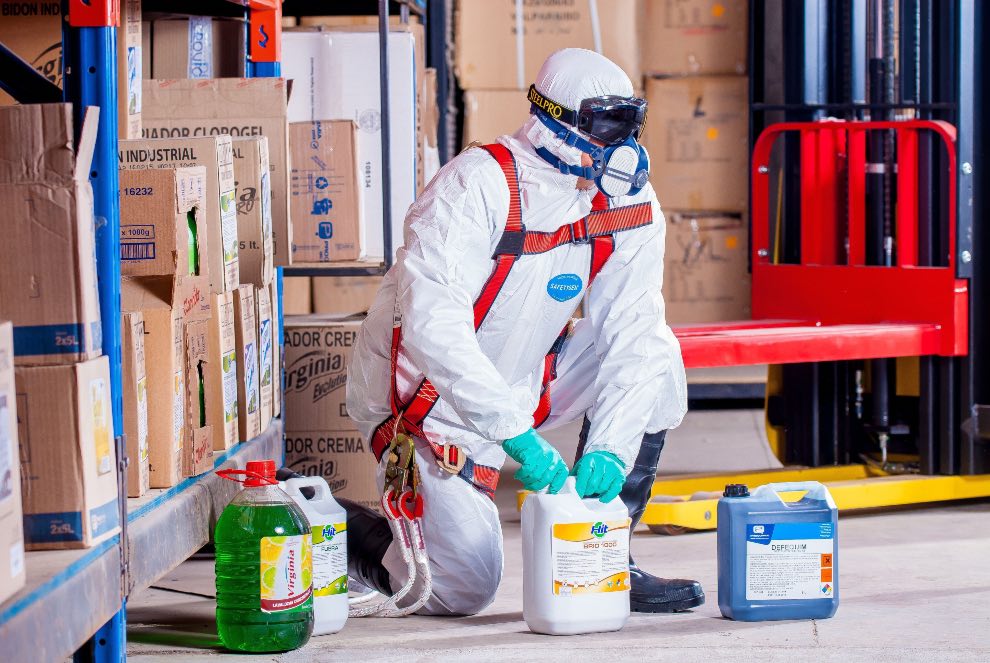
When you do reach PPE, it has to match the substance rather than whatever is left in the cupboard. Corrosives usually need chemical-resistant gloves and a face shield, with the glove material chosen for that specific acid or base. Solvents need a glove with a breakthrough time long enough for the job. Dust and fumes need a respirator rated to the particulate, and any tight-fitting mask needs a face fit test by a competent person, recorded for the wearer, which HSE covers in its own guidance note.
How Often Should COSHH Training Be Refreshed?
Training goes stale faster than most employers expect. A new chemical arriving is a trigger to refresh it, and so is any change to the assessment behind it. An induction video watched once rarely changes behaviour six months later, and it has to show people where the safety data sheets and the spill kit actually live, not just mention them.
Before working with anything unsupervised, a new starter should be able to say what the substance is, what protection it needs, and what to do in the first minute of a spill. If they cannot, the training has not landed, whatever the attendance sheet says.
Where Chemical Safety in the Workplace Actually Starts
Storage, protective kit, training, and assessments all trace back to one thing: an accurate, current list of what is on site. Most failures around chemical hazards in the workplace turn out to be inventory failures wearing a different name, and no amount of paperwork fixes a substance nobody knew was there.
Walk the floor this week. Check what you find against the labels and the safety data sheets you hold; set aside anything that turns out to be lead, asbestos, or radioactive for its own separate process, and fix the rest in the order they could hurt someone.