








Crane Baskets vs. Aerial Work Platforms: What’s the Difference and When to Use Each
Working at height is a critical part of many industries, from construction and infrastructure maintenance to industrial inspections and façade cleaning.
Choosing the right equipment can mean the difference between a smooth, efficient operation and potential operational hazards.
Two of the most widely used solutions are crane baskets (also known as personnel baskets or man baskets) and aerial work platforms (AWPs). While both are designed to lift workers safely off the ground, they serve different purposes, operate under different conditions, and come with distinct advantages and limitations.
This guide breaks down the key differences between crane baskets and aerial work platforms, helping you make the right choice for your specific job requirements.
What Is a Crane Basket?
A crane basket (also called a personnel basket or man basket) is a certified enclosure attached to a crane hook that allows workers to be lifted to height. The basket is suspended from the crane’s load line and is designed to keep operators secure while they carry out tasks at elevation.
Crane baskets can be classified based on their leveling system, which determines how the platform maintains a horizontal position during the lift:
- Gravity (passive) baskets: the basket self-levels naturally through gravity, with no mechanical intervention. Simple, reliable, and well-suited for standard lifting operations on relatively stable ground.
- Controlled-leveling baskets: a mechanical system corrects the basket's angle in a controlled way, providing greater stability when the crane arm shifts or when working on uneven terrain. A middle ground between simplicity and precision.
- Active-leveling baskets: the most technologically advanced option. A hydraulic or electro-hydraulic system continuously and automatically adjusts the platform's position, ensuring maximum stability even in complex or dynamic working conditions.
What Is an Aerial Work Platform?
An aerial work platform (AWP) is a self-propelled or stationary machine that provides temporary elevated access for workers. It includes its own drive system, power source, and controls, making it fully autonomous in operation.
Common types of aerial work platforms include:
- Scissor lifts: ideal for vertical access on flat, stable surfaces, available in electric and rough-terrain versions.
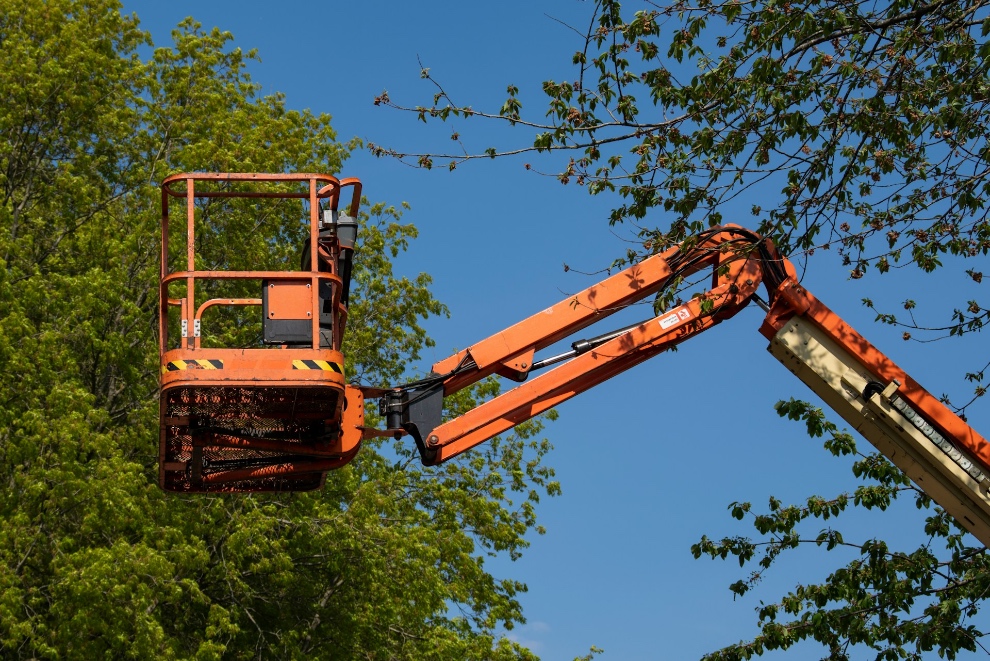
- Articulated and telescopic boom lifts: allow both vertical and horizontal reach, useful when obstacles need to be worked around.
- Tracked (crawler) lifts and spider lifts: designed for soft, uneven, sloped, or confined terrain where standard wheeled machines cannot safely operate.
- Truck-mounted platforms: boom lifts mounted on a vehicle for fast deployment between sites.
Key Differences: Crane Baskets vs. Aerial Work Platforms
Although both solutions are designed for working at height, crane baskets and aerial work platforms differ significantly in terms of operation, flexibility and ideal applications.
1. Reach and Height
Crane baskets can reach elevations far beyond most AWPs (in some cases over 100 meters) while AWPs typically max out between 20 and 60 meters. They are often used for very tall structures such as industrial plants, bridges or high-rise buildings
2. Mobility and Flexibility
AWPs are self-propelled and easy to reposition independently. Crane baskets depend on crane availability and operator coordination for every move. However, on large sites where cranes are already in use, integrating a personnel basket into existing operations is highly efficient.
3. Ground Conditions
Traditional wheeled AWPs require stable, flat ground, though tracked platforms and spider lifts can handle slopes, soft soil, and confined spaces. Crane baskets go further still: as long as the crane is properly set up, the basket can access locations over obstacles, across water, or above terrain that would be off-limits to any ground-based platform.
4. Load Capacity
Both solutions support operators and tools, but capacities vary according to the model. Advanced self-levelling crane baskets can accommodate multiple operators and heavier equipment when needed.
5. Cost and Availability
AWPs are widely available for rental and cost-effective for short-term jobs. Crane baskets require an existing crane, but on large construction sites this overhead becomes negligible, and over time, dual-purposing a crane can prove more economical than running a separate AWP.
When to Use a Crane Basket
Choose a crane basket when:
- Work height exceeds the reach of available AWPs
- Ground conditions prevent safe AWP deployment
- Access is needed above obstacles, water, or irregular terrain
- A crane is already on site and can be utilized for dual purpose
- Precise horizontal positioning is needed (especially with active-leveling models)
- Work involves shipbuilding, wind energy, bridge construction, or industrial maintenance at extreme height
When to Use an Aerial Work Platform
Choose an AWP when:
- Work height is within 20–60 meters and ground is stable
- Frequent repositioning is needed across the site
- No crane is available or the job doesn’t justify crane mobilization
- Indoor maintenance or installation work is required
- Short-duration tasks benefit from quick setup and teardown
Conclusion
Crane baskets and aerial work platforms are complementary tools rather than direct competitors. Each excels in specific scenarios, and the best choice always depends on site conditions, project requirements, height demands, and available machinery.
When a crane basket is the right call, the quality and reliability of the equipment makes all the difference. Platforms by Ormet has been designing and manufacturing certified crane baskets for over 50 years, offering a complete range of solutions, from simple gravity baskets to advanced active-leveling systems, built to meet the highest safety standards and perform in the most demanding environments.
Whether you are working on a construction site, an industrial facility, or a renewable energy project, Platforms provides the expertise and the product range to get your team safely to height.
Gallery